

Fuel, part of which is fissile material.
Moderator, the substance used to maintain the chain reaction
Coolant, the substance used to capture the heat produced in the reactor and transfer it to a steam generator.
From a technological point of view, there are three main types of reactors that have entered industrial use. Click on a specific type to view a detailed description:
Gas-cooled, graphite-moderated reactors (GCR – Gas Cooled Reactor, AGR – Advanced Gas-cooled Reactor) uses uranium as their fuel, graphite as their moderator and compressed carbon dioxide as their heat-transfer medium. This type of reactor was developed for industrial use in the UK and France. There are currently a total of 15 GCR/AGR reactors in operation.
RBMK reactors have uranium fuel and graphite moderators like the GCRs but use water instead of gas to transfer heat. This type of reactor was developed in the former Soviet Union and there still 15 reactors of this type in operation.
Pressurised heavy water reactors (PHWR) use natural uranium as fuel but the moderator is heavy water (i.e. water where the hydrogen is replaced by a deuterium isotope) and pressurised heavy water serves as the coolant. An example of this type of reactor in industrial use is the Canadian CANDU (Canadian Deuterium Uranium), from which several other projects have been derived. At present there are 49 such reactors in the world. Outside Canada, they are found mainly in Asia.
Light Water Reactors (LWR), which use ordinary water as the moderator for enriched uranium fuel and also the heat-transfer fluid, are the most common type of reactor in the world. The category divides into two subtypes:
Boiling water reactors (BWR)
Pressurised water reactors (PWR)
BWRs have a direct cycle, meaning that they produce heat and steam directly in the reactor pressure vessel. They therefore do not have separate primary and secondary circuits but just a single circuit in which the same water serves as a moderator and as a coolant that becomes superheated steam to drive a turbine. Compared to the competing PWR design, it offers a simpler system with the disadvantage of requiring a more complex reactor vessel design and a more complicated control system. There are currently 78 BWR power plants in operation in the world.
PWRs are reactors with an indirect cycle, which means that the pressurised water in the primary circuit, which functions as the moderator and coolant, does not turn the turbines but transfers its heat energy to water in the secondary circuit through steam generators which produce saturated steam to drive electricity production. The advantage of dividing the two circuits is that the steam in the turbine never comes into contact with nuclear fuel and is therefore free of fission products. PWRs are the most widely used reactors: there are currently 279 of them in operation.
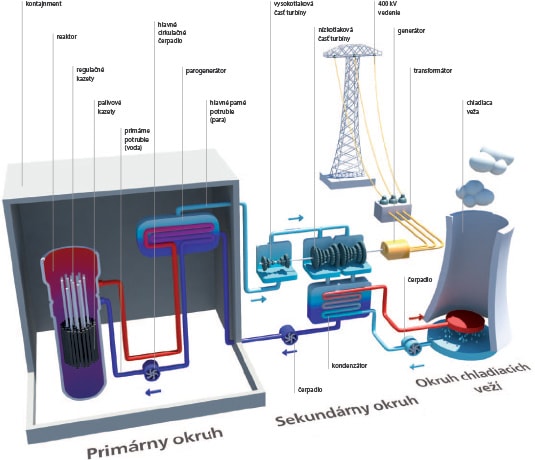
A sub-type of PWR originally developed in Russia is the VVER (transliterated from the Russian for “water-water energetic reactor”). There are 5 reactors of this type operating in Slovakia – two at Bohunice and three at Mochovce. Their only significant difference from western reactor designs is in the engineering architecture, with the primary circuit consisting of 6 loops, or circulation pipes, connecting to six separate steam generators arranged horizontally around the reactor.
Besides the types already mentioned, there are two other noteworthy designs: the high-temperature gas-cooled reactor, which was used in several prototypes in the USA, Germany, the UK and Japan, and reactors based on breeder and fast reactions (FBR – Fast Breeder Reactor), of which ten prototypes were built (in the USA, France, the UK, Germany, Japan and the former USSR) and one large power plant, Superfénix, in France, which began operating with an output of 1,200 MW in 1986 and was shut down in 1996. At present there are no fast breeder reactors working in the European Union.
Almost all commercially operated reactors are based on one of the fundamental water-cooled designs mentioned above. Most new units and current development plans use advanced or Generation III reactor designs. Generation III reactors tend to be larger than their predecessors and have outputs of over 1,000 MW.
They are designed based on knowledge and operating experience acquired over more than half a century of working with previous nuclear installations:
increasing safety, fuel efficiency, operating cycles and power capacity;
lower capital and operating costs;
lower quantities of radioactive waste.
Over the same period, work has progressed on small modular reactors (SMRs) which are intended for locations with lower demand, more isolated regions and more modest budgets. Small reactors are designed to produce up to 300 MW of electricity and employee various technologies. Their development is most advanced in the USA, Russia, China, France, Argentina and South Korea.
Even as the Generation III reactors slowly enter operation, nuclear scientists from around the world are working together to build Generation IV reactors. There are currently six design proposals under review. Even so, it will take several decades for the most promising proposal(s) to be ready for testing.