
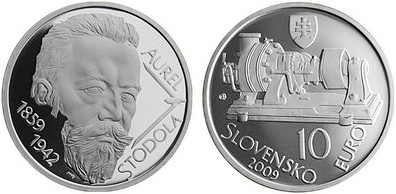
Aurel Stodola is the face of the first Slovak commemorative euro coin. Its nominal value is 10 euros. The silver coin was issued in 2009 on the occasion of the 150th anniversary of his birth.
„This letter struck my mind like a bomb, and I am faced with so much determination that I find it difficult to find any discomfort," he wrote to his family in Liptovský Mikuláš at the time. "I go to write first that I do not feel called to a place of the first rank like Zurich, and that too in the mathematical field, and ask how those gentlemen themselves imagine my position if I do not answer? I beg you also to write me back what is your opinion from your position (but without delay).“
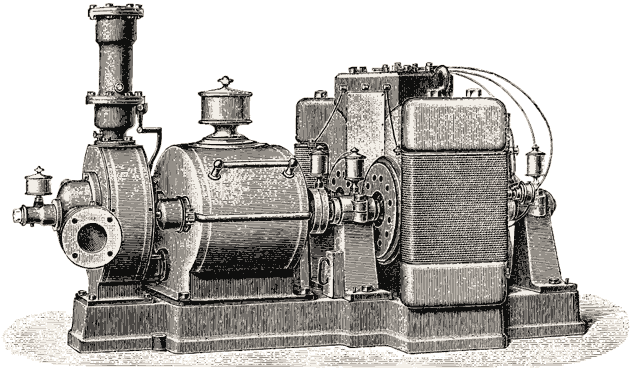
Stodola eventually accepted the invitation and remained faithful to the Zurich Polytechnic, from which he himself graduated, until his retirement, a full 37 years. This despite other lucrative offers from European universities and engineering companies. He left a deep mark on the school as a scientist and teacher. As head of the Department of Mechanical Engineering, he devoted himself to the new field of steam turbines and gas (combustion) turbines. He foresaw the immense development and use of these thermal machines so accurately that his theoretical studies and mathematical calculations are still relevant today.
In 1903 he became famous for his seminal work Die Dampfturbinen und ihre Aussichten als Wärmekraftmaschinen (Steam Turbines and their Prospects as Heat Machines). In it, Stodola summarised practically all the previous knowledge in the field of steam turbines, to which he himself had made a substantial contribution. The work was published in several editions, which Professor Stodola continuously supplemented, the sixth one in 1925 being a publication with 1157 pages and 1141 drawings and 14 diagrams. Translated into Russian, French, English and Chinese, it has been read as a classic textbook by several generations of mechanical engineers throughout the world.
Aurel Stodola had a reputation as an excellent teacher. He was said to have such a pace that students had to divide tasks in his lectures - some wrote down what he said and others redrew his designs from the blackboards.
„If he had been born during the Renaissance, he would have become a great painter or sculptor, because the greatest impulse of his personality was the need to create and imagination. He transmitted this powerful enthusiasm to his students through the long and long years of his fruitful teaching. Although the main driving force behind his work was the flowering of creative activity, yet his strength was in the constant thirst for knowledge and the extraordinary clarity of his ideas.“
Albert Einstein
about his friend Aurel Stodola
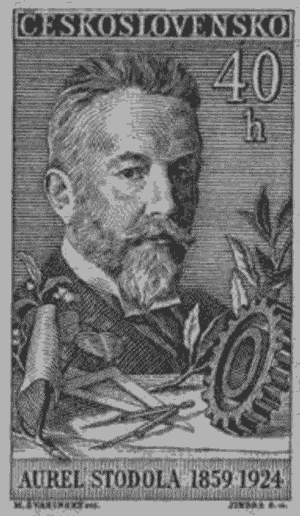
The stamp with Aurel Stodol is a philatelic rarity - it gives the wrong year of death.
Many of the world's scientific societies and universities have awarded him the highest honours and ranks. He was also a corresponding member of the French Academy of Sciences. In 1928 he buried his elder daughter, whose voluntary departure from this world he bore very badly and decided to retire. However, he did not stop publishing.
He died on 25 December 1942 in Zurich. Since 1989 he has been buried in Liptovský Mikuláš.
Although he lived most of his life abroad, he was very interested in the part of his family that remained in Slovakia, as well as in what was happening at home, and he never gave up on Slovakia.
(Based on materials for the exhibition on the occasion of the 150th anniversary of the birth of A. Stodola: Janko Kral Museum, Liptovský Mikuláš, wikipedia)