

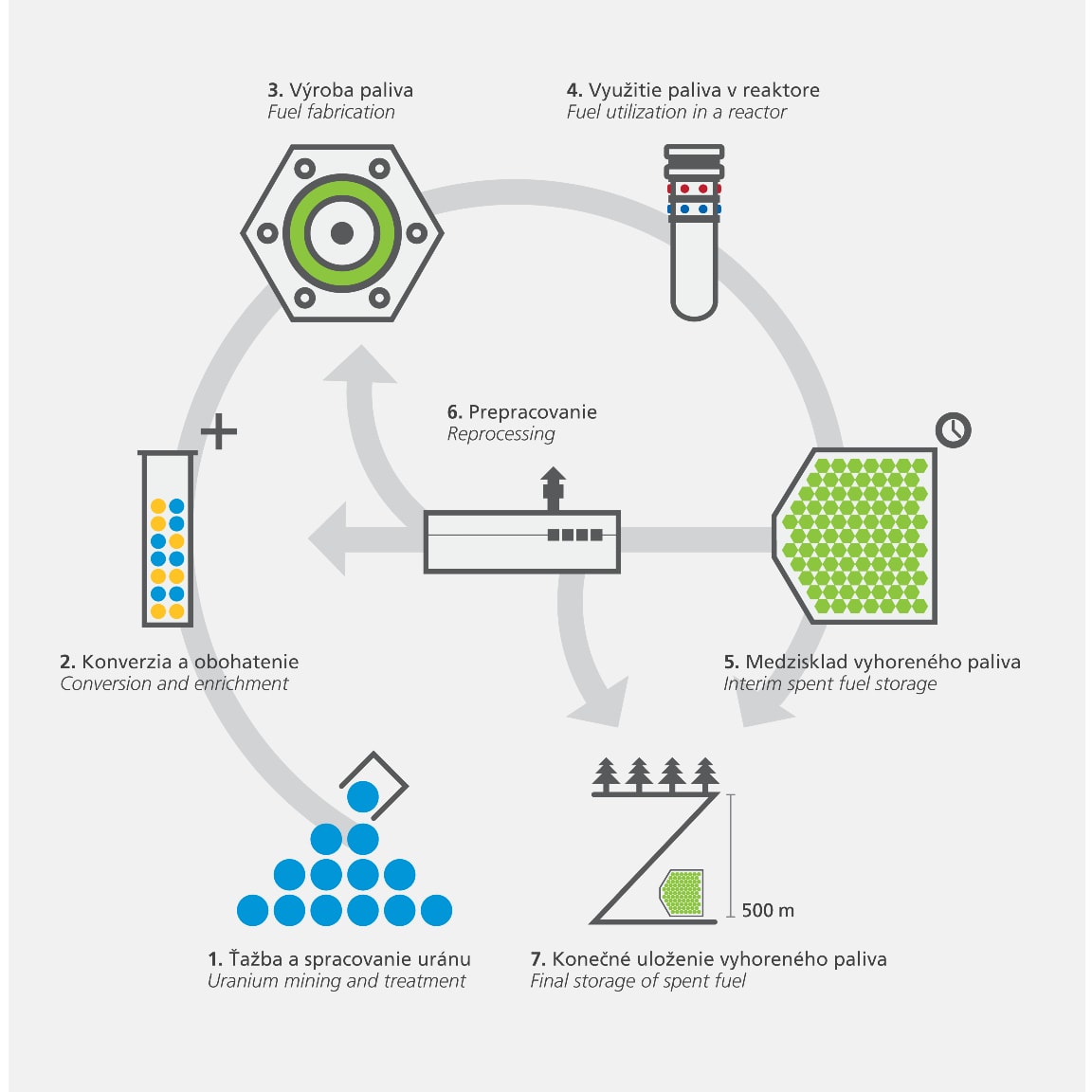
Uranium ore is mined in underground and surface mines. The uranium content in ore ranges from 0.1% to 3%. The most uranium ore is mined in Canada, Australia and Kazakhstan. The ore is crushed and treated with chemicals (leaching) to obtain yellowcake, which contains more than 80% uranium.
The uranium compounds contained in the yellow cake are converted into a gaseous form (uranium hexafluoride – UF6), which is more suitable for enrichment with fissile uranium 235. Uranium obtained from natural sources usually contains a mixture of two isotopes: U-238 and U-235. The main fissile isotope is uranium-235 but it makes up a relatively small proportion of natural uranium compared to uranium-238 (0.7% on average), whereas for use in nuclear fuel, its share should be increased (enriched) to almost 5%. The most widespread enrichment technique is centrifuging.
UF6 is chemically processed into UO2 (uranium dioxide) powder. This is pressed and sintered at a high temperature (1400°C) into ceramic tablets that are hermetically sealed in zirconium steel rods. A fuel assembly consists of 126 rods. The operation of one VVER-440 reactor requires between 7 and 9 tonnes of uranium fuel each year. Fresh nuclear fuel does not represent a radiation hazard because it is initially only a weak source of radiation that is activated by its insertion into a reactor.
The heat energy released during the fission of uranium in the reactor is removed by the coolant (water) and then used to generate electricity in a turbine generator. The fuel in the reactor must be covered by water at all times otherwise it could overheat; at temperatures of over 1500°C the fuel cladding would start to melt and at over 2500°C the fuel itself would melt. Some of the U-238 in the fuel becomes plutonium in the reactor. The main isotope of plutonium is itself fissile and contributes around a third to the energy released in the reactor.
After 5 to 6 years of operation in the reactor, the fuel is transferred to the spent fuel pool, which is right next to the reactor. Here it cools down and its radioactivity decreases. Water provides an excellent shield against radiation while absorbing the residual heat produced by the spent fuel. After 5 years of cooling, the spent fuel can be transported to the spent fuel storage facility at Bohunice, where it is kept in pools of water. This storage facility, which is operated by the state-owned company JAVYS, a.s., currently houses all the spent nuclear fuel found in Slovakia. In future, there are plans to increase its storage capacity with a dry storage facility (storage in special containers cooled only by natural air circulation).
Spent fuel consists of around 95% uranium, 1% plutonium and 4% highly radioactive fission products, which are produced in the reactor. The fuel can be recycled at reprocessing plants where it is separated into three components: uranium, plutonium and high-level waste. The uranium and plutonium can be reused to make fresh nuclear fuel containing a mixture of their fissile isotopes, which is known as MOX fuel.
Reprocessing is both expensive and energy intensive so there are only a few reprocessing plants in the world. Spent fuel from the power plants of Slovenské elektrárne is not currently reprocessed but this possibility has not been ruled out in future.
The globally accepted solution for the final deposition of spent nuclear fuel is placing it in special containers in a deep geological repository. The selection of a safe location for construction of a deep repository must consider strict requirements for the rock or sediment surrounding it. Although there is currently no deep repository for spent fuel in operation in the world, several countries (e.g. Finland, Sweden, Switzerland) have built demonstration research units to study and verify the safety and feasibility of such projects. The first deep geological repository is expected to become operational in Finland around 2020.
From Slovakia’s point of view, there is no urgent need to address this issue because the total volume of spent fuel is relatively small and can be held in the storage facility for a long time without problems. Slovenské elektrárne pays the applicable statutory contributions to cover the future costs of managing spent nuclear fuel, radioactive waste and the decommissioning of nuclear power plants. The National Nuclear Fund manages these contributions and ensures the implementation of tasks resulting from the national programme for the final stage of the peaceful use of nuclear energy in the Slovak Republic. As part of the current national programme for the final stage of the peaceful use of nuclear energy, a geological survey of sites suitable for the construction of a repository is also underway in our country. It is believed that a final repository could become operational around 2065.
There is also ongoing research on other possible uses for spent fuel enabled by new technologies. One promising line of research is fast breeder reactors, which could, in future, be powered by the spent fuel from our current generation of reactors. this seems like the optimal solution for the back end of the nuclear fuel cycle.