At the end of the seventies it was considered to use the flow from the Hnilec River, which is transferred through the Pumping Hydroelectric Power Plant (PVE) Dobšiná to the Slaná River basin. As a result of these efforts, the Dobšiná II Hydroelectric Power Plant (HPP) was commissioned in 1994 and the Dobšiná III HPP was commissioned at the end of 2013.
Compromised technical solution
Initially, several technical solution alternatives were considered. They differed in different designs for the location of the small hydropower plant, water abstractions from the reservoir, lengths of the waste channel or turbine depths. The use of Kaplan, Banki and Francis turbines was envisaged. The maximum gradients ranged from 7.20 to 20.00 metres and the installed capacities from 0.188 to 0.700 MW.
The technical solution is a compromise between the ideas of Slovenské elektrárne as the owner and operator of the power plant, and Slovenský vodohospodársky podnik, š. p., as the administrator of the stream and the balancing reservoir.
HPP after and during construction
In the end, the mutual cooperation managed to combine the individual objectives and build a work that is economical, produces ecological energy and has no negative impact on the environment, while accepting the requirements of the flow manager.
Unattended and fully automatic
The plant may be small in terms of output and generation, but in terms of complexity of design, implementation and engineering complexity it can be the equal of its much larger sisters. It is unmanned, fully automatic, and its control is considerably more complex than that of a hydroelectric plant, which is built as a conventional river stage. The control and information system of the power plant allows the operation to be controlled directly from the hydropower control room in Trenčín, if necessary from the Dobšiná hydroelectric power plant, or manually directly at the hydroelectric power plant.
It produces 1.5 gigawatt hours of electricity
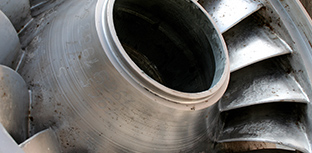
The Dobšiná III hydropower plant has an installed capacity of 0.253 MW, a design gradient of 9.80 metres and a flow rate of 3.20 m3/s. In an average wet year it will produce 1 485 MWh of electricity. It generates electricity using one horizontal Kaplan turbine with an impeller diameter of 0,75 m and an asynchronous generator. The main structures (intake structure, intake feeder, powerhouse and waste trough) are designed in monolithic water-concrete construction. To give a better idea of the scale of construction, the feeder is 1.50 x 1.50 metres square and 57 metres long.