
Experts predict that in the long term our electricity consumption will grow. One possible low-carbon and stable source to satiate the hunger for energy is the construction of small modular reactors. At the beginning of the year, therefore, representatives of the company Sargent & Lundy visited Slovakia to carry out the initial phase of a field survey of sites for a feasibility study on the construction of small modular reactors (SMRs). Although Slovenské elektrárne, a.s. has yet to commission Unit 4 of the Mochovce Nuclear Power Plant, the company already needs to think beyond 2030, as the construction and licensing of new energy sources is a long-term and highly complex process.
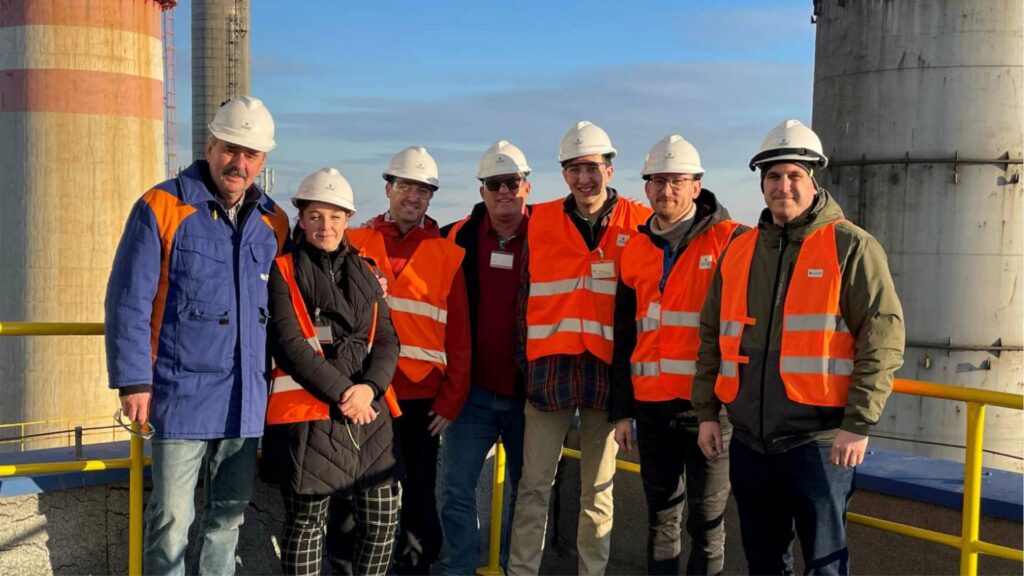
Sargent & Lundy is one of the world's longest established full-service architectural engineering firms and a global leader in the power, electrical engineering, and decarbonisation sectors. Three American experts from this company were introduced to the specific conditions of Slovenské elektrárne power plants and guided through the NPP Bohunice, NPP Mochovce, TPP Nováky and TPP Vojany sites.
The study process is divided into several stages. It starts with the definition of the so-called KO criteria – excluding a particular site from selection due to any serious constraint, e.g. seismicity, unsuitability of the geological subsoil or surroundings, lack of cooling water. This is followed by a survey of suitable sites and selection of the most suitable ones. In the next phase, the most appropriate SMR technologies for each selected site are assessed. Finally, a licensing plan and a capital cost analysis of the alternatives is prepared.
A number of factors enter into the analysis, such as the purpose of the SMR - electricity generation, heating or cogeneration, or existing infrastructure, climatic, geological and geographical conditions, as well as the cooling water availability. However, there are also other socio-economic and environmental factors that may influence the final choice of sites.
Although no SMR technology under consideration has yet been licensed for operation, the study will consider a number of projects that are currently in the process of finalizing design and should be in the process of being licensed by some state nuclear regulatory authorities by the time our study is completed. These are being developed by NuScale, X-energy, Holtec, Kairos, KAERI, Westinghouse, GE-Hitachi, EDF, Terra Power, and Rolls-Royce.
The abbreviation SMR originally stood for Small and Medium Reactors. According to the International Atomic Energy Agency, small reactors are those up to 300 MW and medium reactors are those up to 700 MW power output. However, a different interpreting of Small Modular Reactors (SMRs) has taken hold around the world. It reflects the changes that the nuclear industry and its concepts have undergone since the 1980s.
Small Modular Reactors (SMRs) are a paradigm-shifting technology in the power industry. Compared to traditional nuclear units with a capacity of over 1000 MW, they are really small. For example, the UK's Rolls-Royce is presenting a 470 megawatt small modular reactor. While this is comparable to the output of the new unit at Mochovce, it is a small resource compared to the 1600 MW EPR reactors. Large reactors are difficult to regulate and pose a challenge for small electricity grids such as Slovakia's. Compared to them, SMRs bring several advantages.
It is important to note that SMRs are not just a scaled-down version of the original large pressurised water reactors. SMRs offer a wide range of concepts with their own advantages and unique features, attractive to a changing energy market in Europe that is looking for flexible, efficient and sustainable solutions for the future.
The first advantage is their modularity. It allows the number of reactors at a site to be adapted to energy needs - for example, in the case of the Nu-Scale concept, which envisages modules with a unit capacity of 77 MW in arrangements of 4, 6 or 12 modules. Modularity is also reflected in the way individual components are manufactured and transported. This feature reduces costs and simplifies logistics.
Another advantage is flexibility. Current large nuclear plants have limited flexibility to respond to changes in demand in the daily electricity market. SMR concepts are more controllable in this respect, which is an important benefit for the stability of electricity networks.
Fuel cycle closure - some SMRs are the 4th generation concepts and use spent nuclear fuel to generate electricity, which contributes to more efficient use of resources, reducing the volume of spent fuel and the costs associated with its final disposal.
The Economy of Scale rule also applies to the small modular reactors. This means that they cost less, but are still expensive per unit of power - at least until the benefits of modular construction are realised. That is, until they are produced in large numbers. In addition to small power systems, such as Slovakia's in Europe, small reactors also have the prospect of being used in remote places on the Earth where the transmission grid cannot reach - military bases, for desalination in desert areas with access to the sea, or in thermal power generation, hydrogen production or space exploration.
The first reason is the changing energy sector – both the demand for electricity and the flexibility of electricity generation are expected to increase in the coming decades. However, a growing share of renewables, even in combination with storage or hydrogen generation, will not be able to meet these needs, so we need to look at emission-free sources that will meet demand in the baseload band of the grid and also allow for better regulation of power on the electricity system. However, Slovakia needs to reduce its dependence on fuel and technology suppliers and must diversify supply.
Climate protection and emissions reduction – potential development of SMRs can help to achieve the country's climate goals and address future energy needs. The EU was among the first to declare the need to decarbonise and achieve carbon neutrality by 2050. In Slovakia, Slovenské elektrárne is ending coal combustion and shutting down all its coal-fired power plants – Nováky and Vojany.
We need to develop our know-how - Slovenské elektrárne has extensive experience in the field of nuclear energy. We are one of the first countries to use nuclear energy for peaceful purposes. We also must extend our knowledge in the field of SMR.
GRANT FOR FEASIBILITY STUDY
In 2023, Slovenské elektrárne together with its partners - the Ministry of Economy of the Slovak Republic, U.S. Steel Košice, the Slovak Power Transmission System, VUJE, the Nuclear Regulatory Authority of the Slovak Republic and the Slovak University of Technology in Bratislava - received funding from the U.S. Government for the feasibility study of small modular reactors (SMRs) in Slovakia. The purpose of this study is to assist Slovakia in transitioning from coal combustion to the deployment of civilian nuclear reactors, including SMRs and other advanced reactor designs, in a manner that prioritizes nuclear safety, non-proliferation, security of energy supply, and sound financial considerations from the outset.